
Don’t find your answer here? Just send us a message for help
Frequently Asked Questions
Portable Appliance Testing, commonly known as PAT Testing, is the process of inspecting and testing electrical appliances to ensure they are safe to use. It involves a combination of visual inspections and specialist electrical tests designed to identify faults, damage, or potential safety risks.
PAT Testing itself is not specifically required by law. However, UK legislation including the Electricity at Work Regulations 1989 requires employers, landlords, and organisations to ensure electrical equipment is maintained in a safe condition.
PAT Testing is the most widely accepted method of demonstrating compliance with these regulations.
PAT Testing is recommended for all businesses and organisations that use portable electrical equipment, including:
- Offices
- Schools and colleges
- Landlords and letting agents
- Hotels and hospitality businesses
- Shops and retail premises
- Factories and warehouses
- Healthcare facilities
- Construction sites
Most portable electrical appliances should be inspected and tested, including:
- Computers and monitors
- Kettles and microwaves
- Extension leads
- Power tools
- Printers and photocopiers
- Vacuum cleaners
- Kitchen appliances
- Chargers and adapters
In general, any electrical appliance with a plug may require testing.
There is no fixed legal frequency for PAT Testing. The recommended interval depends on:
- The type of appliance
- How often it is used
- The environment it is used in
- The likelihood of damage
High-risk environments such as construction sites may require more frequent testing than low-risk office environments.
Our PAT Testing service includes:
- Visual inspection of plugs, cables, and appliances
- Earth continuity testing
- Insulation resistance testing
- Polarity testing where required
- Operational checks where appropriate
- Appliance labelling and asset identification
Every appliance tested receives a pass or fail label.
At Safety Testing (UK) Ltd, we aim to minimise disruption wherever possible. Testing can often be carried out during normal working hours, evenings, or weekends depending on your requirements.
Our engineers work efficiently to ensure minimal downtime for your staff and operations.
The time required depends on the number of appliances and the type of environment being tested. Smaller offices may take only a few hours, while larger commercial sites may require additional time.
We can provide an estimated timescale before work begins.
If an appliance fails inspection or testing, it will be clearly labelled as failed and recorded in the test report. We will explain the reason for failure and advise whether the item should be repaired, replaced, or removed from service.
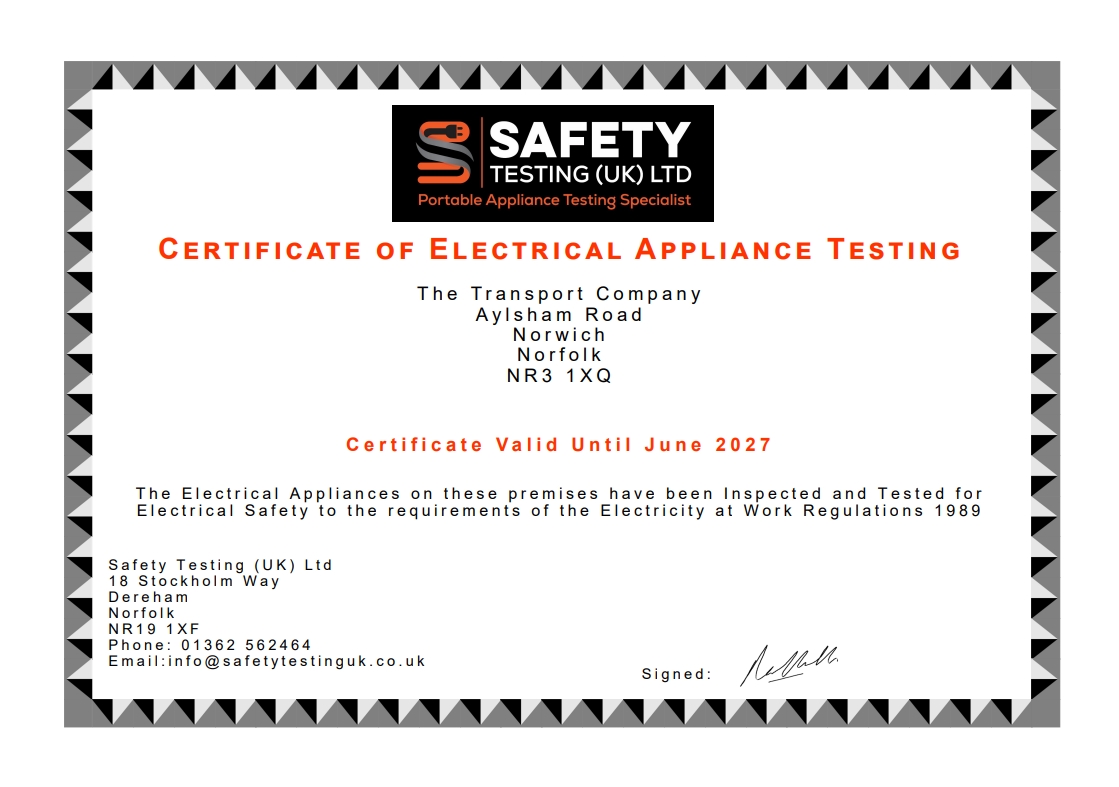
Yes. Following completion of testing, Safety Testing (UK) Ltd provides:
- A PAT Testing Certificate
- A detailed asset and test report
- Records of passed and failed appliances
- Appliance identification labels
These records help demonstrate compliance with health and safety responsibilities.
Yes. We use specialist low-current “soft testing” methods for sensitive IT and computer equipment to prevent damage during testing procedures.
With over 25 years of industry experience, Safety Testing (UK) Ltd provides professional, reliable, and competitively priced PAT Testing services across East Anglia.
We are committed to delivering:
- Fast response times
- Flexible appointments
- Minimal disruption
- Detailed reporting
- Excellent customer service
- Full compliance support