
The Legal Requirements for PAT Testing

At Safety Testing (UK) Ltd, we are often asked whether Portable Appliance Testing (PAT Testing) is a legal requirement. While the law does not specifically state that PAT Testing must be carried out, UK legislation does require all employers, landlords, and organisations to ensure that electrical equipment is maintained in a safe condition.

PAT Testing is the most widely recognised and effective method of demonstrating compliance with these responsibilities.
UK Electrical Safety Regulations

Several key pieces of legislation place a duty on businesses and property owners to maintain electrical safety, including:

  • Electricity at Work Regulations 1989
  • Health & Safety at Work Act 1974
  • Provision and Use of Work Equipment Regulations 1998
  • Housing Act 2004

These regulations require that electrical equipment capable of causing injury is properly maintained and safe to use.

Why Choose PAT Testing?

Regular PAT Testing helps businesses and organisations to:

  • Reduce the risk of electrical fires and electric shock
  • Identify faulty or damaged equipment early
  • Protect employees, tenants, customers, and visitors
  • Demonstrate compliance with health and safety obligations
  • Support insurance and risk management requirements
  • Maintain accurate maintenance and safety records

At Safety Testing (UK) Ltd, we provide professional, reliable, and cost-effective PAT Testing services designed to help you meet your legal responsibilities with minimal disruption to your business.

Who Needs PAT Testing?

PAT Testing is recommended for all organisations using portable electrical appliances, including:

  • Offices and commercial premises
  • Schools, colleges, and universities
  • Landlords and letting agents
  • Hotels and hospitality venues
  • Shops and retail environments
  • Factories and warehouses
  • Healthcare facilities
  • Construction and industrial sites

Whether you operate a small office or a large multi-site organisation, maintaining electrical safety is an essential part of your duty of care.

How Often Should PAT Testing Be Carried Out?

There is no fixed legal timescale for PAT Testing. The recommended frequency depends on several factors, including:

  • The type of appliance
  • The working environment
  • Frequency of use
  • Risk of damage or misuse

For example, equipment used in construction or industrial environments will generally require more frequent inspection than equipment used in low-risk office settings.

Certification & Record Keeping

Although keeping PAT Testing records is not a strict legal requirement, the Health & Safety Executive (HSE) strongly recommends maintaining detailed records of inspections, testing, and maintenance.

Following completion of testing, Safety Testing (UK) Ltd provides:

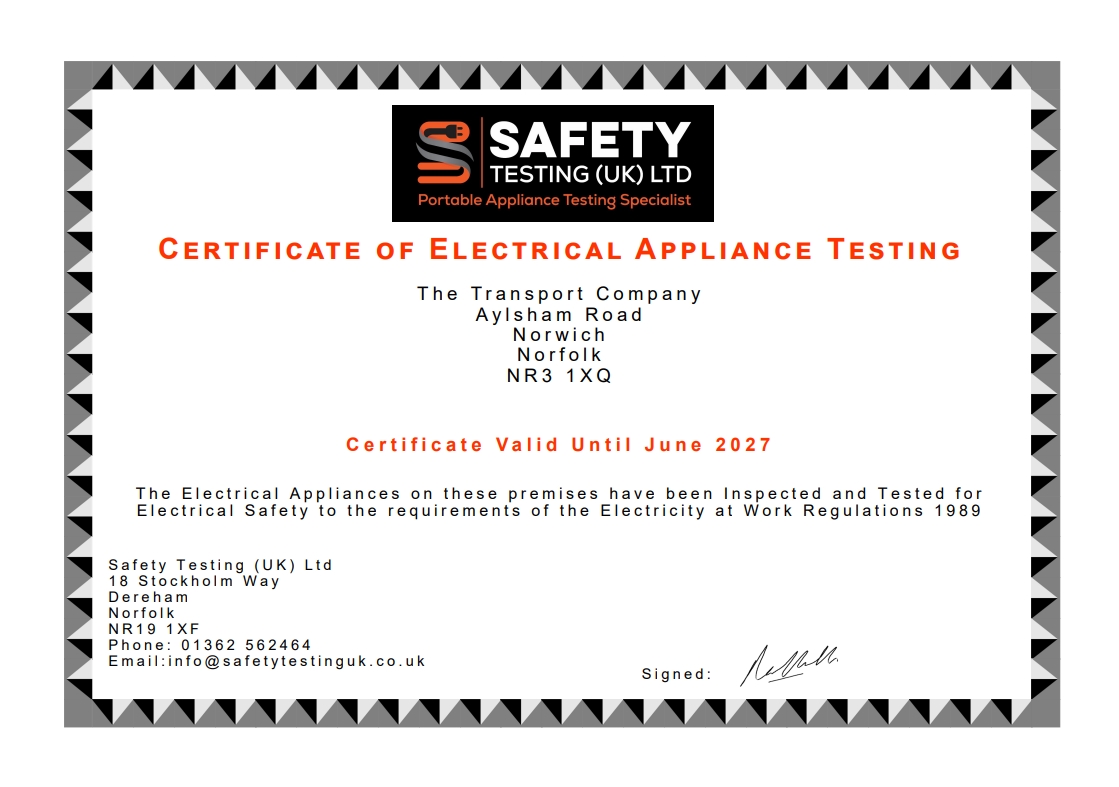
  • A PAT Testing Safety Certificate (View Example)
  • A detailed asset register and test report (View Example)
  • Pass or fail labels for every appliance
  • Clear identification of failed or unsafe items

These records provide valuable evidence of compliance and help businesses monitor equipment condition and plan future testing schedules.

A safety testing certificate for electrical appliances, featuring black and white triangular borders, orange text, and a signature.

Trusted PAT Testing Across East Anglia

With over 25 years of industry experience, Safety Testing (UK) Ltd delivers fast, professional, and dependable Portable Appliance Testing services to businesses and organisations throughout East Anglia.

Contact us today to arrange your PAT Testing inspection or to discuss a tailored electrical safety programme for your business.